The $14.6M Axon Contract: What's Actually In It
tldr; The city signed a $14.6 million contract with Axon in June. Starting September 1 it puts 20 new plate readers, 200 in-car cameras that read plates as they drive, drones, counter-drone radar, and 227 body cams onto one police screen. Along with the 181 traffic cameras and 19 parks cameras we already own.
"Plate reader" was said zero times at the council meeting presenting it.
What we're building
- Fixed cameras
- 20 new solar plate readers on poles. Plus the 70 Flock readers and 5 Flock PTZ cameras already up. Behind those, 250 video streams wired into the police platform...181 Traffic Engineering cameras, 19 Parks cameras, and about 50 slots left open for private cameras people register. Those city cameras arent plate readers. The department can switch AI object detection on for any of them.
- In the air
- 3 drone dock sites that launch to 911 calls with no officer present. Plus a patrol kit and a team kit. Counter-drone radar and RF sensors show up in 2031.
- On officers
- 227 body cameras. 29 eight-bay docks. 200 licenses to live stream those cameras into the platform. A 227 seat Axon AI license. 200 TASER 10s with a VR training suite.
- In vehicles
- 100 patrol cars get two-camera Axon Fleet 3 kits. Thats 200 in-car cameras on 5G routers, and Axons in-car line reads plates as the car drives. Squad car locations feed the same screen through dispatch.
- Tying it together
- Axon Fusus is the one screen. Plate reads from three separate systems, drone video, body cam streams, 911 caller locations, vehicle positions.
Contracted through August 2036. Hardware lands August 1 2026. The ten year clock starts September 1.
What are we already running?
| Vendor | System | Value | Runs to |
|---|---|---|---|
| Vigilant Solutions owned by Motorola since 2019 ↓ contract ↓ amd. #4 |
Mobile plate readers on squad cars since 2015, plus a hosted plate-data platform | $24,350/yr | Jun 25 2026 |
| Flock Safety ↓ contract |
70 fixed plate readers and 5 PTZ video cameras | $499,250 | Oct 31 2026 |
| Axon ↓ contract |
Tasers | $709,853 | Dec 31 2027 |
| Axon ↓ contract |
The technology package, see below | $14,598,446 | Aug 31 2036 |
| Sensys Gatso ↓ contract ↓ amd. #1 |
15 red-light and speed cameras. No contract value...the vendor gets $22 per paid red-light ticket and $17 per paid speeding ticket | per ticket | Jun 30 2027 |
| Motorola Solutions owns Vigilant |
Police and fire radios, APX Next Phase 3. Not surveillance | $1,950,000 | Jun 30 2034 |
| Keltek / MacQueen ↓ contract ↓ amd. #6 |
Body cameras, and automated redaction software for body-worn and in-car video | $2,400/yr | Dec 31 2026 |
Whats in the $14.6M?
The council description reads "public safety equipment, hardware and software." The pricing schedule inside the signed contract is specific.
| Item | Qty | What it is |
|---|---|---|
| Axon Outpost camera | 20 | Solar powered fixed plate readers. Poles, installation, ten years of maintenance, and a 2031 hardware refresh |
| Vehicle Intelligence ALPR license | 20 | Plate reader software licenses, Sept 2026 through Aug 2036 |
| Axon Fusus | 250 streams | The central platform. 250 camera feeds plugged into it...see below for where they come from |
| Skydio drones + docks | 3 dock sites | Drone as First Responder, launching to 911 calls from fixed docks. Plus one patrol kit and one team kit. Goes to three OSP docks in 2031 |
| Axon Dedrone radar | — | Counter-drone detection. Long range radar and RF sensors |
| Axon Fleet 3 in-car cameras | 100 cars | Two-camera kits on 5G. Thats 200 cameras. Axons in-car line reads plates as the car drives |
| Body cameras | 227 | Plus 29 eight-bay docks, live streaming, and 60 language translation |
| Axon AI licenses | 227 | "AXON AI – AI ERA," one per body camera, on a 108 month term |
| Auror retail crime hub | 200 | Third party retail crime intelligence network |
| TASER 10 | 200 | With the VR training suite |
Across the full transcript of that 21 minute presentation to council, "ALPR" and "plate reader" appear zero times. Neither do the drones. Neither does the radar.


Where do the 250 streams come from?
They arent new cameras. This isnt a replacement for what we have, its a hub. A planning document inside the contract called the Fusus Qualifier Summary lists exactly what gets plugged in.

| Phase | Source network | Cameras |
|---|---|---|
| Phase 1 | Traffic Engineering | 100 |
| Phase 2 | Traffic Engineering, the rest | 81 |
| Phase 2 | Parks | 19 |
| Identified | 200 | |
| Unallocated, open for registered private cameras | ~50 | |
Phase 1 is "connect up to 100 CCTV video streams." Phase 2 is "deploy remaining core streams across the jurisdiction." These are the city's existing traffic and parks networks getting connected to a police platform.

Do those traffic cameras read plates now?
No. And they probably cant.
The line item is called "CCTV AI streams," which sure sounds like plate reading. It isnt, for two separate reasons. One is in the contract. One is physics.
The statement of work is worth quoting exactly:
"The Agency is responsible for identifying which streams should be configured for AI object detection. The actual number of AI streams available is contingent upon stream characteristics and hardware capabilities, as not all CORES support AI analytics."
Object detection. Not plate recognition. And CRPD picks which streams get AI turned on, after deployment, so that decision appears nowhere in the contract. Not every camera can even have it. Depends on the edge hardware.

The platform isnt built to read plates off ordinary video anyway. Axons own documentation describes Fusus as taking plate reads in from dedicated systems instead of generating them...the sources it lists are Axon Fleet 3, Axon Outpost, "Works with Axon" partner cameras, Jenoptik Vector, Vigilant Solutions and Flock Safety. The contract says the same thing from the other end. Fusus connects to IP cameras "using industry-standard RTSP and ONVIF protocols." Thats a generic video pipe.
So the traffic and parks cameras land on the police platform as what they are. Live video, searchable by location, some of it flagged for crowd or intrusion alerts. The plate reads come from the plate readers. This doesn't mean those traffic engineering cameras won't be upgraded in the future.
The contract does name the AI functions, and theyre narrower than "AI" makes them sound: "Supported AI functionality may vary by configuration type, including crowd detection, or object intrusion zone detection." Crowd detection counts people in a scene. Intrusion zone detection fires when something crosses a line somebody drew on a map. Neither one reads a plate.


Which plate readers feed the Fusus AI?
"Expected ALPR Integrations: Fleet3 LPR; Flock ALPR; Milestone xProtect LPR"
Fleet3 LPR is Axons in-car camera. Axons own cooperative contract classifies the Fleet line as an ALPR product. Flock ALPR is the existing 70 camera network. So the platform is built to take plate reads off our own patrol cars and off the Flock network, on top of the 20 Outpost readers the contract buys outright.
Vigilant isnt on the list. The squad car readers weve run since 2015 arent named as an expected integration, and its not because the platform cant take them. Vigilant is one of the ALPR sources Axons own documentation lists as supported in Fusus. It could have been named. It wasnt. Seems like vigilant isn't going to be renewed based on the data we have.

And the rest of it. The same document lists Hexagon Intergraph for dispatch and automatic vehicle location, so live police vehicle positions land on the same screen. Plus RapidSOS caller location and Skydio drone feeds.
Add it up. Roughly 200 municipal cameras, three plate read sources, registered private cameras, drone video, 227 body cams and 200 in-car cameras with live streaming, vehicle positions, and 911 caller locations.
How we got here
-
2012
In-car cameras
Baycom Arbitrator squad car camera system. A decade before Axon.
↓ agreement -
May 2015
Chapter 60A
Named business types required to install surveillance and give police live access.
↓ ordinance -
July 2015
Vigilant, first plate readers
$31,700, approved unanimously. Paid from a meth enforcement grant and asset forfeiture.
↓ resolution ↓ agreement -
May 2016
70 traffic cameras, for signal timing
Added to 20 already up. These become the Axon platform's Phase 1 and 2 streams.
↓ resolution -
January 2018
First city drones
Three UAS on Homeland Security grant money, one stationed with Iowa Task Force 1.
↓ MOU -
April 2021
Vigilant enterprise license
Six readers for two cars, $46,860. Renewed by signature in 2022, 2023, 2024 and 2025.
↓ contract ↓ amd. #4 -
September 2022
Axon Tasers
$709,853, running to December 2027. The city's first Axon contract.
↓ contract -
April 2024
A plate camera at the bus garage
One AXIS Q1700-LE among 56 cameras in a Transit replacement.
↓ contract -
November 2024
Flock goes live
70 fixed cameras. Approved June 2024 at $499,250. The two year clock ran from installation.
↓ contract -
February 2025
A mobile Flock trailer, by grant
CRPD applies to Iowa Homeland Security for a camera trailer "which integrates with our current Flock camera system."
↓ application -
April 14 2026
Chapter 60A re-enacted
Business camera mandate carried forward. Technical minimums updated on police recommendation.
↓ resolution -
April 2026
Axon equipment trial
CRPD trials Axon in-car and body cameras free for 90 days.
↓ agreement -
June 23 2026
The $14.6M package approved
Ten year term, September 2026 to August 2036. Roll call.
↓ contract -
June 25 2026
Vigilant's term ends
No Amendment #5 in the portal.
↓ amd. #4 -
September 1 2026
Axon term begins
Outpost cameras scheduled to arrive August 1. Three plate reader systems running at once.
-
October 1 2026
Flock decision window closes
Thirty days out. The notice date under both readings of the contract.
↓ contract -
October 31 2026
Flock term ends, or renews
Renewals from here run November through October.
↓ amendment
Flock Renewal is Oct 31st - How does it renew?
October 31 2026. The Flock contract either ends or rolls for two more years.
Nobody can tell you which, because the contract contradicts itself. Section 7.1 says it auto-renews unless someone gives 30 days notice to stop it. Section 7.2, one paragraph down, says the city has to actively ask for the renewal in writing 30 days out. Silence means yes under one and no under the other. Nothing in there says which clause wins.
Either way the deadline is October 1. The date itself never went to council. It got moved to October 31 on a City Manager signature last October, because the cameras went in later than planned.
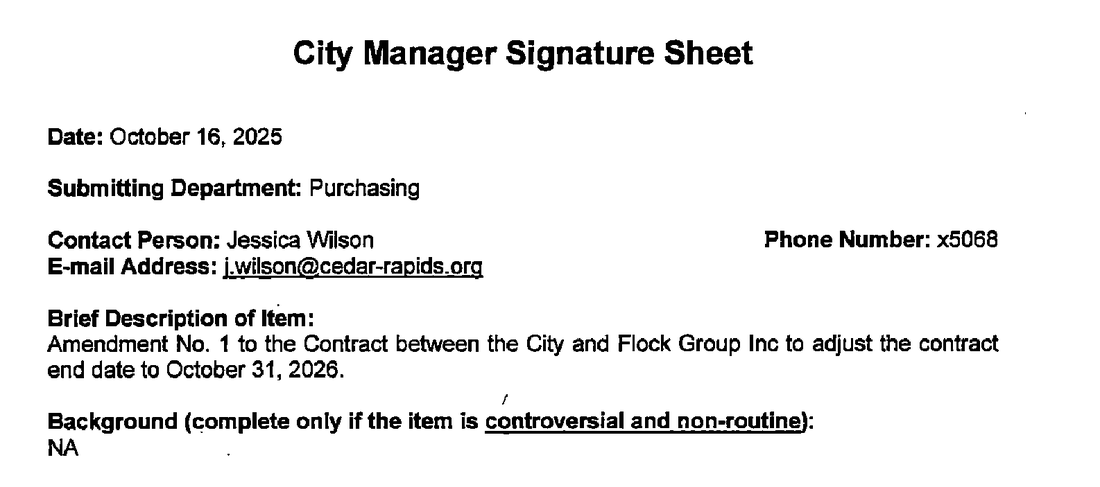
PUR0424-254, Amendment No. 1.
Open the original


Check it yourself
Every ↓ link above opens the signed document on the city's own portal. If one breaks, theyre all findable by hand.
Go to the Cedar Rapids public records search. Set Search Type to Public Contracts, Resolutions and Ordinances. Put the contract number in the CIP/DID # box.
PUR0424-254 Flock · PUR0822-039 Vigilant ·
PUR0526-344 Axon package · PUR0822-052 Axon Tasers ·
OB449776 Sensys Gatso · PUR0122-180 redaction software
· OB1380220 Chapter 60A · PUR1215-116 traffic cameras
· PD0079 Flock camera trailer
This is all pretty much a done deal without something massive changing. All we can do at this point is to make sure your council members know this is happening. Im betting most are unaware that we are getting ready to add and additional 20 Fixed ALPR cameras. Let them know that the Flock contract is up for renewal as well.
Small print: Built from 363 signed contract documents, 2,545 pages, off the City of Cedar Rapids public contracts portal, plus council packets, presentations and the June 23 2026 meeting transcript. The core documents behind this report — including the full 164-page council packet — are posted in our document archive. Anything else is available on request.
2,227 of those pages were scans nobody could search. It wasnt hidden. It was just unreadable.